23rd January 2019
There was a full cruise day after Aruba before we reached the entrance to the Panama Canal, a farewell to the Caribbean, which had treated us well: calm seas, blue skies, heat, and plenty of great views and memories.
We picked up the pilot somewhere out to sea at 5.30 am. The canal was on both our bucket lists, but that didn’t include greeting this essential participant at such an ungodly hour. I was on deck with my camera just after six; it was still not fully light, though already uncomfortably humid. Sue ventured out shortly after, but somehow we didn’t see each other again until lunchtime.
I watched fascinated as we passed beneath the unfinished Atlantic Road Bridge, the first obstacle to navigate before reaching the initial set of three locks. The tannoy announced that the bridge was soon to open at a cost of 350 million dollars. Leaning on the railing at the bow, I mischievously whispered to the Scotsman beside me, “Hrm, we could have done that for 2.4 billion.” He nodded in agreement. “With a two-year delay on delivery,” he added. This third-world country doesn’t know what it’s missing.
As the light strengthened, the decks quickly filled with eager bucket listers, and even the crew began gathering on the topmost deck, where the off-limits radar equipment is located. Everyone was desperate to capture a shot to impress friends and family back home. I rely on the ‘quantity method’, click away as much as possible, and surely at least one will turn out well. Won’t it?
The Gatun Locks mark the edge of the rainforest, its dense canopy just metres from the waterway and surrounding buildings. To raise ships high enough to enter the vast man-made lake, there are three consecutive locks. They are impressive, but not quite large enough; through the trees in the distance, we caught glimpses of a new canal under construction, designed to accommodate the latest generation of mega-ships. I just hope it doesn’t cost the 800,000 lives that the original one claimed before completion.

We were following the cruise ship Norwegian Star, which was just leaving the first lock as we arrived to couple up to the ingenious machines that would first pull, then drag us to a stop between the sets of gates. We watched and photographed as the Norwegian Star rose inside each body of water, gradually revealing more of her hull with each ascent. The transit through this first set of locks seemed to captivate everyone; no one abandoned the decks to partake in the usual activities below. Each huge lock took 15 minutes to fill.
Moving from one side of the ship to the other, or from bow to stern, in pursuit of the perfect photo was no easy task, given the sheer number of bodies clutching cameras and phones. Most were reluctant to give up their hard-won positions, even briefly, to let others pass. Well, I didn’t play rugby for 40 years for nothing!
Alongside the locks, railway tracks run parallel to the waterway, similar to those on mountainous funicular railways, except these remain flat, aside from a short incline leading up to the next lock. Waiting for us on these tracks were four small locomotives, two on each side. We nudged up to a long dock just before the locks, held steady by two tugs positioned fore and aft, their thrusters churning the water like a giant washing machine. As we hovered in place, the first two locomotives squeaked and squealed their way towards us, attaching what appeared from my vantage point to be ridiculously thin cables to our (by comparison) leviathan. What do I know? As the cables tensioned, we inched forward into the lock, where two additional locomotives on the opposite side latched on in a similar fashion. They had no trouble tugging us into position and bringing us to a controlled stop within each of the three locks. For obvious safety reasons, ships are not permitted to use their own engines during transit.
It was fascinating to watch, and as a distraction, we also observed a couple of container ships passing in the opposite direction through the parallel locks alongside us.
With the locks behind us, we entered Gatun Lake, once the largest lake in the world, though now ranking only third. The sun was fierce during our nearly eight-hour steam across this vast body of water, and finding shade while observing the passing jungle-clad islands and shoreline became a priority for most, except the foolhardy. Many had their binoculars trained on the canopy in search of wildlife, though sightings seemed limited to a variety of large, vibrantly coloured birds. Other creatures, it appeared, had declined the CMV appearance fee as too derisory.

Our pilot kept us informed over the Tannoy of anything of interest as we passed by. One particular highlight was the jungle prison we quietly slipped past, where, we were told, the President of Panama is currently enjoying its facilities. I wonder who he upset?
Around two-thirds of the way through our journey, we passed the small town of Gamboa, nestled on the shoreline. It seemed less like a traditional town and more like a resting place for the vast earth-moving machinery that maintains the canal, with relatively few homes or buildings visible for those who service the system.
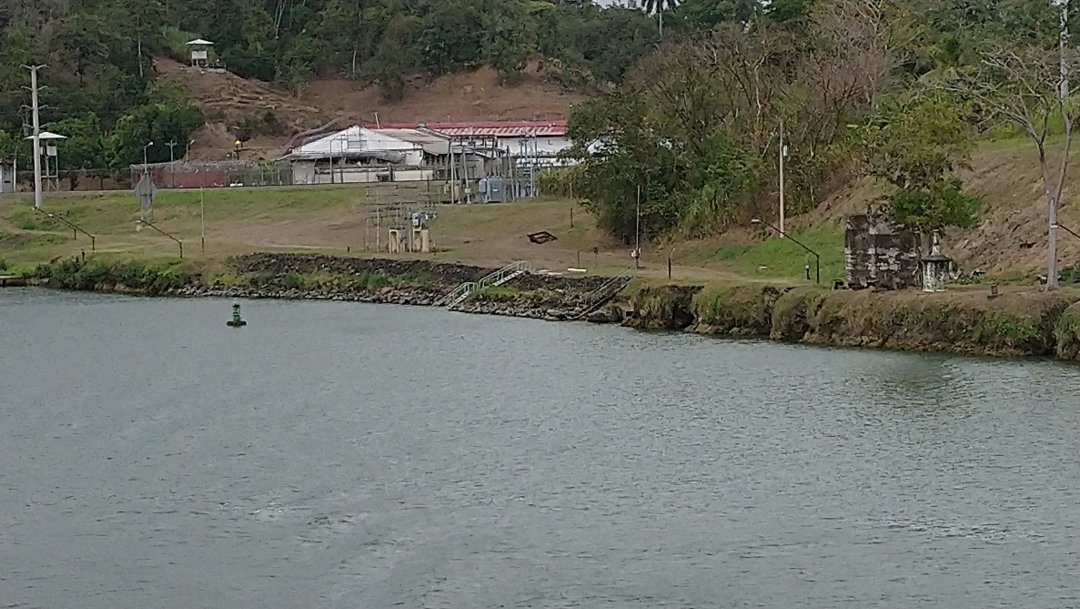
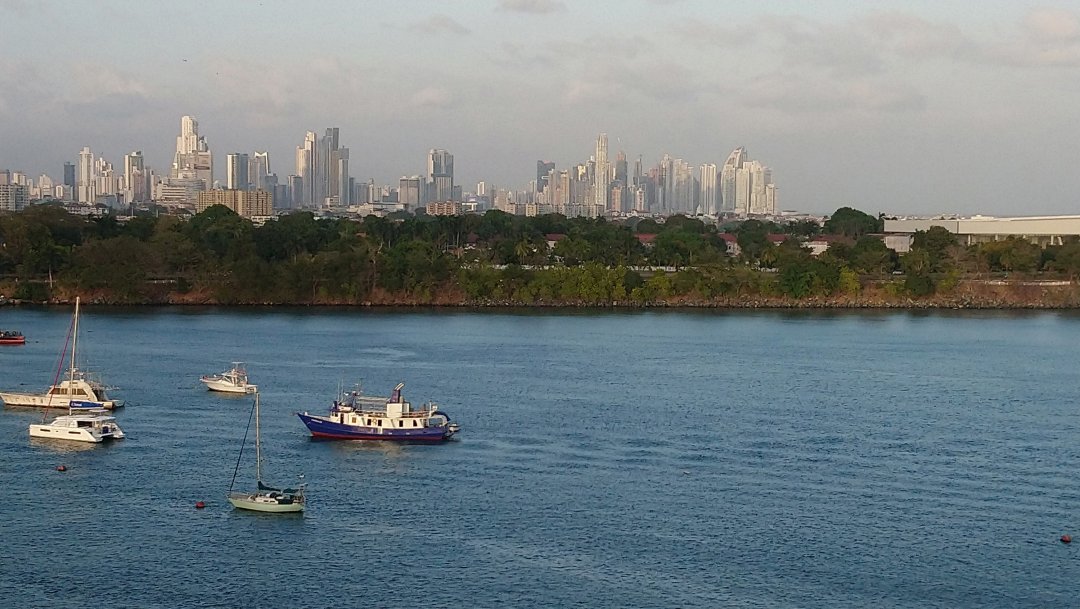
The next set of locks is the Pedro Miguel Locks, followed by the smaller Miraflores Lake and then the double Miraflores Locks before we finally reach the Pacific Ocean. By this point, the watching passengers had thinned out. The restaurants had opened for the evening, and, to avoid the threat of starvation, some felt the need to indulge in a few more calories. No doubt, they too were equally astounded by the view from their dining room windows: Panama City rising dramatically from the verdant jungle in the distance. It was truly awe-inspiring, with the late afternoon sun glinting off the enormous towers of concrete and glass. It was a statement of humanity’s ability to bend any environment to its will. It city is huge!
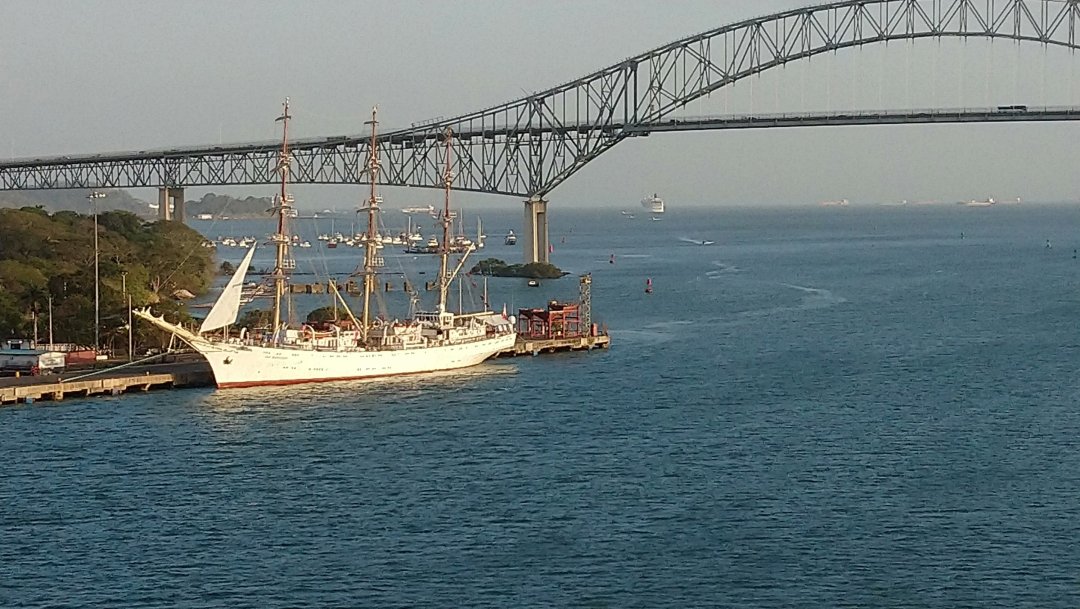
As the sun set, we sailed beneath our final bridge, which carries the Trans-American Highway, into the bay. We found a space and dropped anchor, joining the countless other ships already there. We were stopping for several hours to refuel before continuing our journey. Somehow, a tanker found us in the dark, and by 2 am, it had discharged its cargo into our bunker, allowing us to set off once again.
Ahead lie two more sea days before our next stop in Guatemala. I wonder what the Pacific Ocean has in store for us?


Leave a comment